
Content coming soon. Please check back shortly...
Media training is an essential part of corporate life and can be a daunting affair to be thrown-into situations without knowing what to expect. Broadcast simulation training can take you and your staff through up to four levels of broadcast interview simulation, so when your staff do find themselves put in front of the media, they will have an expectation of how the scenario will play-out.
Previous satisfied clients include NHS and Premier Inn
Telephone Interview

We have all had uncomfortable phone calls, but having a phone call broadcast live whilst a journalist is looking for their gotcha moment can raise anxiety levels to another level.
Course attendees will be phoned from another room and asked questions relating to a pre-imagined incident. Course attendees will be guided how to answer questions and find-out what they should and shouldn't reveal. Telephone calls are recorded for future reference.
Radio Interview
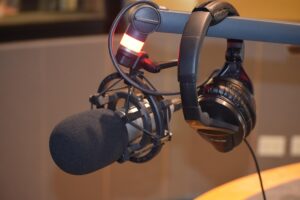
Radio stations can be an intimidating place to be interviewed and we are here to simulate the radio station environment, so should your staff find themselves in this scenario, they will feel more at ease and make the entire experience a more comfortable experience.
Sitting across a table, with broadcast microphones and headphones monitors. After a brief sound check with the producer, you will be briefed and then into the interview. Talking face-to-face with a broadcast journalist and their stack of notes. Hearing your own voice in your headphones, whilst having to speak into a microphone and trying not to get caught-out by the journalist's interview.
Interviews are recorded and edited with jingles to give a realistic simulation of a radio interview.
Green Screen TV Studio
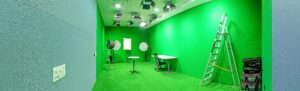
Many television studios, especially news studios are now little more than a green room, with the studio imported into the picture as graphics to be broadcast live. As a result, It can be a very intimidating space to be in. There is bright studio lighting, wireless clip-on microphones and if your staff have never experienced this atmosphere, it can feel completely alien and not what you want to be experiencing for the first time, just at the moment you have to partake in a tricky TV interview.
Course attendees will be interviewed and coached on how to achieve the most professional results.
The simulations can be shown live to other members of the course with the graphics overlaid for maximum impact.
Down The Line Interview

Down-The-Line interviews are the remote interviews often seen on the news. We see them as a head and shoulders shot with a scenic background, often with the TV presenter sitting in front of a screen broadcasting the interviewee.
There is very little human interaction before the interview starts. Course attendees will be sent to another room, where the down-the-line studio is built. They will put in an earpiece and look into a camera, with a bright light to distract them. They won't see the person interviewing them, but only hear them in the earpiece. It can be a very disorientating experience, but one where many serious TV interviews take place. Just think of how many politians you have seen "on the line from Westminster" in this way
The interview is recorded and edited in a way to simulate how the broadcast would look in reality.
Debrief
At the end of the day-long session, there will be a debrief and conclusion to see where course attendees can improve, should they be put in this situation in real life. It is a valuable training exercise in a world where news clips can go viral and around the world in seconds. Broadcast Simulation gives your staff the opportunity to learn how to give a comprehensive interview, no matter where it is taking place.
Broadcast Simulation Training is conducted in collaboration with a trained Media Consultant. If you are interested in this service, please contact me and I will arrange for my partner to contact you.